
An Hour of Video Checked in a Few Minutes: How I Fact-Check YouTube Links with Claude
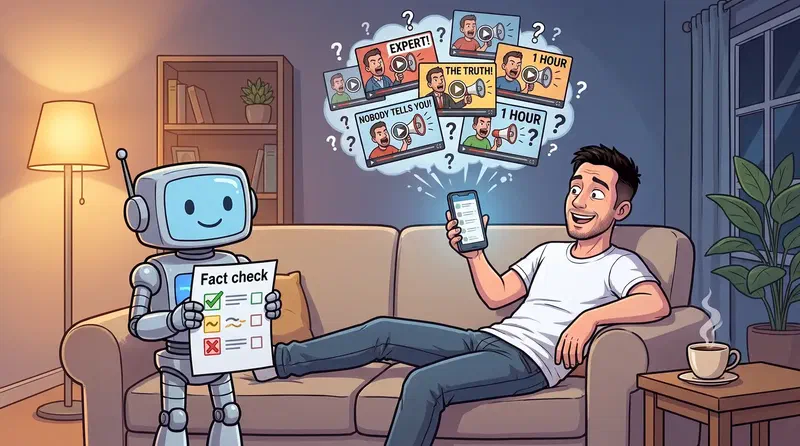
Economy, energy, climate, AI: my contacts keep posting links to long YouTube videos. Instead of watching for an hour, I hand the link to Claude and get a fact check with sources – correct, partly correct, wrong.
🌐 Also available in: Deutsch · Français · Español · Italiano · Português · Nederlands · Polski
In short: My contacts keep posting links to YouTube videos in their status – on the economy, energy, climate or AI. Often they come from people who have a firm opinion on every topic and consider themselves smarter than the experts in that field. I am often sceptical, but I do not have an hour to watch each video. Now I hand the link to Claude. Claude reads the subtitles, checks the claims and turns the result into a PDF: what is correct, what is partly correct and what is wrong, with sources. It takes a few minutes instead of an hour. The most interesting part for me was not a single error but a pattern.
Table of Contents
📱 How it started: videos in my contacts’ status
It started quite unspectacularly. Lately I have seen a striking number of YouTube links in my contacts’ status. The topics vary: economy, energy, climate, artificial intelligence. The videos are often long; an hour is not unusual.
And often it is the same kind of “expert”: people with a firm opinion on every subject who basically believe they know more than the professionals who have spent a working life on exactly that field. Some of it sounds plausible, some does not. With a lot of it I simply cannot tell.
My problem: I want to form my own opinion, but I do not have the time to watch an hour of video for every link and then research the numbers on top.
🤖 The idea: Claude reads the subtitles
Funnily enough, the solution came from a corner I normally use for very different things. I run my servers and write my Ansible playbooks with Claude, Anthropic’s AI. At some point I thought: why not for this as well?
The process is simple:
- I send Claude the link to the video.
- Claude takes the subtitles, i.e. the spoken text. Most videos have them, often generated automatically. Without subtitles it does not work. The cleanest way, by the way, is through YouTube itself: choose “Show transcript” below the video, copy the text and give it to Claude.
- Claude splits the text into individual, checkable claims and checks each of them: history and technology from its own knowledge, current figures by searching the web.
- Finally, Claude creates a PDF for me.
📄 What comes out of it
The PDF is clearly structured, with coloured tables:
- ✅ Correct
- ⚠️ Partly correct or imprecise
- ❌ Wrong, each with the correct value
- ❓ Unsupported or not checkable
For each claim the position in the video is listed, so I can listen to exactly that part if I want. Often Claude also includes links to the sources right away – official statistics, official documentation or specialist articles. That way I can follow the check myself.
It is also important to me that Claude separates facts from opinions. Opinions such as “this is the wrong way to think about it” or “politics has failed” are not rated as true or false. Only factual claims are checked: numbers, dates, quotations, technical details.
And the time it takes: for a video of a little over an hour, the result was ready after a few minutes. Not seconds – Claude has to read the text, do research and build the PDF – but compared with an hour of video and an evening of research it is a fraction.
🔍 The most interesting result: errors that all point the same way
With a long video on energy and the economy, something stood out in Claude’s analysis. At the beginning almost everything was correct: history of technology, dates, many current facts. From a certain point on, the errors piled up: a miscalculated charging time, an inventory set too low, a clearly exaggerated per-day figure, a wrong comparison between countries.
What was remarkable was not the number of errors but their direction. Every error supported the video’s thesis. Someone who simply researches sloppily makes errors in both directions – sometimes too high, sometimes too low. When every deviation leans the same way, that is at least a clear warning sign. It does not prove intent, but it is a good reason to treat the rest of the video with more distance.
To be fair, the counterexample too: another video, an essay on AI and three old books, came through with almost no objections. The facts were right, opinions were clearly recognisable as opinions, and nothing was pushed in one direction. So the method does not check “against” particular opinions. It simply shows how carefully a video handles facts.
⚖️ What I keep in mind
I have set myself a few rules for this:
- The analyses are for me. I use them to form an opinion, not to publish them. That is also why I do not name any people, channels or video titles here.
- I do not pass on transcripts or screenshots. The text of a video belongs to its creator.
- I prefer the clean route via “Show transcript” on YouTube.
🧠 And the AI itself? Stay critical
As practical as it is, I do not believe the AI blindly. There are good reasons for that:
- Automatic subtitles mishear things. A misrecognised number in the subtitles quickly turns into an apparent error in the video.
- Claude can be wrong too. That is why Claude marks what comes from its own knowledge and what was freshly researched. For important points I look at the linked sources myself.
- Recent events need research. What happened only a few weeks ago, Claude can only know through web search.
- In the end I judge for myself. Claude gives me a well-founded tendency, not the truth.
🎯 Conclusion: a new, very everyday way of using AI
- An hour of video checked in a few minutes. For me that is the biggest gain: I can engage with a topic without sacrificing the whole evening.
- Spot patterns instead of counting single errors. Whether errors scatter randomly or all point one way often says more than any single error.
- Sources instead of claims. The links to the evidence make the check traceable.
- I still stay critical – of the AI as well. But at least I now take a reasoned tendency away from a video instead of just a gut feeling.
And the nice part: I brought Claude in for servers and code, and found a use I would never have thought of before.