Mijn eerste Python-project: een nerdy ASCII-galgjespel
🌐 Ook in: English · Deutsch · Français · Español · Italiano · Português · Polski
Ik ben nu een paar dagen met Python aan het rommelen — vooral theorie: variabelen, loops, conditionals en de gebruikelijke verdachten. En zoals elke verstandige beginnende programmeur besloot ik dat mijn eerste “echte” project iets episch moest zijn.
Dat werd dus uiteraard… galgje.
Het is de perfecte uitdaging voor beginners:
- Je oefent met variabelen door de geraden letters en foute pogingen bij te houden.
- Je gebruikt loops voor het verloop van het spel.
- Je strooit er conditionals doorheen om te bepalen wie leeft en wie sterft (nou ja, in ASCII).
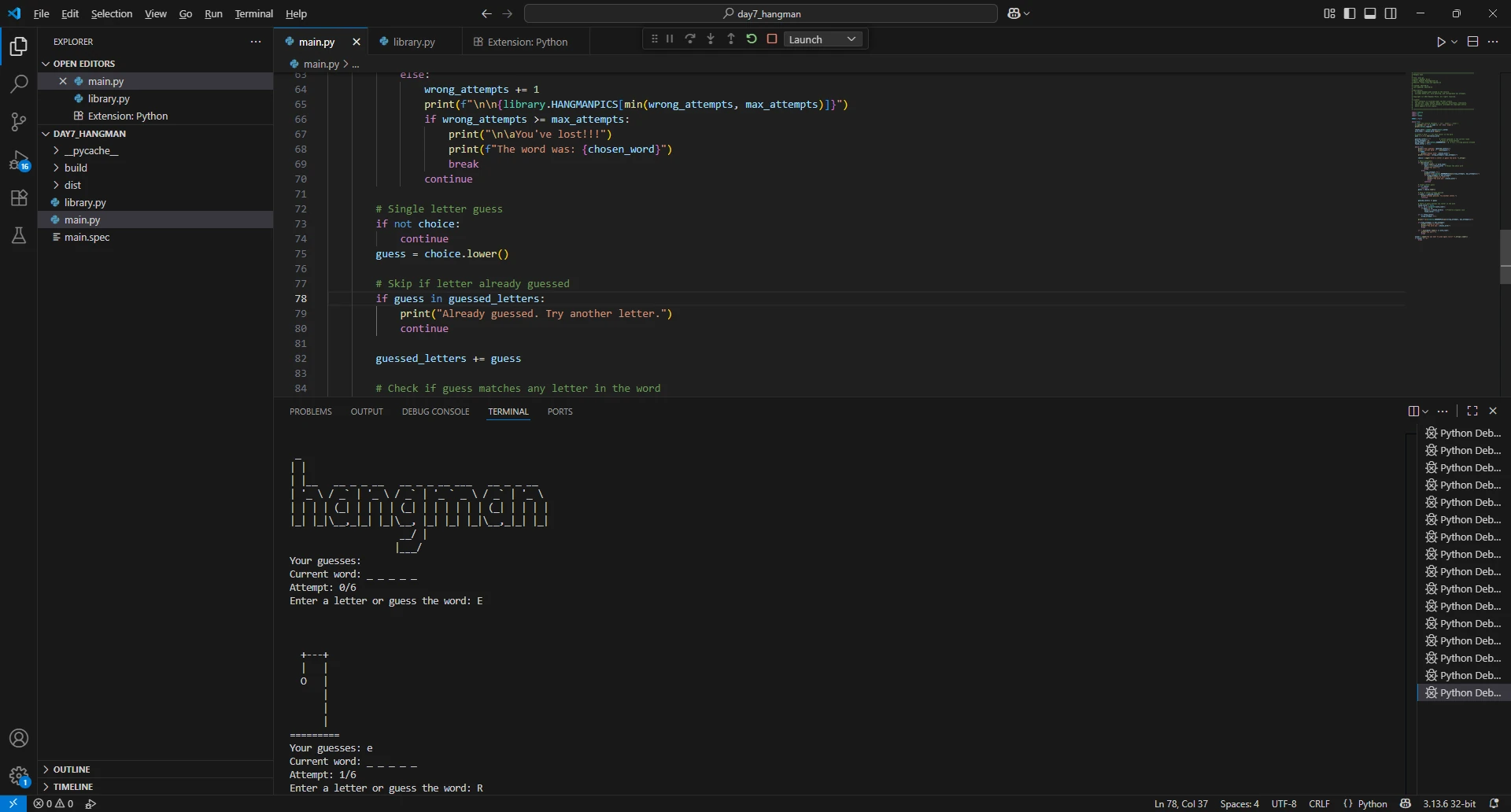
Na wat vallen en opstaan (en flink wat “O ja, Python is hoofdlettergevoelig”) kreeg ik mijn versie aan de praat. Ik geef toe dat ik ChatGPT een paar stukken heb laten “pimpen” — maar hé, zo leer je sneller, toch?
Wat het doet
- Kiest een willekeurig woord uit een vooraf gedefinieerde lijst
- Toont bij elke foute gok een ASCII-poppetje
- Laat je letters of het hele woord raden
- Kan overweg met hoofdletters, kleine letters en herhaalde gokken
- Pronkt met mijn groeiende Python-superkrachten
Waarom ik het zo leuk vind
Het is niet zomaar een spel — het is een kleine tijdcapsule van waar ik nu sta in mijn programmeerreis.
Over een paar maanden kijk ik hierop terug en denk ik: “Wauw… ik heb een flinke weg afgelegd.”
Maar voor nu is het puur genieten als mijn terminal volloopt met underscores, ASCII-art en overwinningsberichten (of tragische nederlagen).
Tot slot
Begin je met Python? Maak een galgjespel. Echt. Het is de perfecte speeltuin om te experimenteren met loops, logica en de magie van ASCII. En als je je code er netjes uit kunt laten zien en zonder bugs kunt laten draaien, heb je al gewonnen.
library.py
words = ["Apfel", "Banane", "Mango", "Kirsche", "Pfirsich", "Linux", "Kernel", "Docker", "Ansible", "Python"]

logo = ['''
 _
| |
| |__   __ _ _ __   __ _ _ __ ___   __ _ _ __
| '_ \ / _` | '_ \ / _` | '_ ` _ \ / _` | '_ \
| | | | (_| | | | | (_| | | | | | | (_| | | | |
|_| |_|\__,_|_| |_|\__, |_| |_| |_|\__,_|_| |_|
                    __/ |
                   |___/''']

HANGMANPICS = ['''
  +---+
  |   |
      |
      |
      |
      |
=========''', '''
  +---+
  |   |
  O   |
      |
      |
      |
=========''', '''
  +---+
  |   |
  O   |
  |   |
      |
      |
=========''', '''
  +---+
  |   |
  O   |
 /|   |
      |
      |
=========''', '''
  +---+
  |   |
  O   |
 /|\  |
      |
      |
=========''', '''
  +---+
  |   |
  O   |
 /|\  |
 /    |
      |
=========''', '''
  +---+
  |   |
  O   |
 /|\  |
 / \  |
      |
=========''']
main.py
# =============================================================================
# Hangman Game
#
# File: main.py
# Author: Raphael Münch
# Email: you@example.com
# Website: https://www.apt-upgrade.me
#
# Created: 2025-08-15
# Last Updated: 2025-08-15
#
# Description:
#   A simple Hangman game played in the console.
#   Includes ASCII art, word guessing, and configurable max attempts.
#
# Copyright (c) 2025 Raphael Münch. All rights reserved.
#
# License:
#   This software is licensed under the MIT License.
#   You may use, copy, modify, merge, publish, distribute, sublicense,
#   and/or sell copies of the Software, provided the copyright notice
#   above appears in all copies.
#
# =============================================================================

import library
import os
import random

DEBUG = False

while True:
    # Clear the console (Windows = 'cls', others = 'clear')
    os.system('cls' if os.name == 'nt' else 'clear')
    print(library.logo[0])

    chosen_word = random.choice(library.words)
    word_lower = chosen_word.lower()

    # Create a mask: "_" for each letter in the word
    mask = ["_"] * len(chosen_word)

    guessed_letters = ""           # Letters guessed in the current round
    wrong_attempts = 0              # Count of wrong guesses
    max_attempts = len(library.HANGMANPICS) - 1  # e.g., 6 wrong guesses allowed
    found_letter = False

    while True:
        print(f"Your guesses: {guessed_letters}")
        print(f"Current word: {' '.join(mask)}")
        if DEBUG:
            print(f"Chosen word: {chosen_word}")
        print(f"Attempt: {wrong_attempts}/{max_attempts}")

        choice = input("Enter a letter or guess the word: ").strip()

        # Whole word guess
        if len(choice) > 1:
            if choice.lower() == word_lower:
                mask = list(chosen_word)  # Reveal the whole word
                print("You win!!!")
                break
            else:
                wrong_attempts += 1
                print(f"\n\n{library.HANGMANPICS[min(wrong_attempts, max_attempts)]}")
                if wrong_attempts >= max_attempts:
                    print("\n\aYou've lost!!!")
                    print(f"The word was: {chosen_word}")
                    break
                continue

        # Single letter guess
        if not choice:
            continue
        guess = choice.lower()

        # Skip if letter already guessed
        if guess in guessed_letters:
            print("Already guessed. Try another letter.")
            continue

        guessed_letters += guess

        # Check if guess matches any letter in the word
        found_letter = False
        for i, ch in enumerate(word_lower):
            if guess == ch:
                mask[i] = chosen_word[i]   # Preserve original case
                found_letter = True

        if not found_letter:
            wrong_attempts += 1

        print(f"\n\n{library.HANGMANPICS[min(wrong_attempts, max_attempts)]}")

        if wrong_attempts >= max_attempts:
            print("\n\aYou've lost!!!")
            print(f"The word was: {chosen_word}")
            break

        if "".join(mask).lower() == word_lower:
            print("You win!!!")
            break

    answer = input("Do you want to play again (y/n)? ").strip().lower()
    if answer != "y":
        break