Mój pierwszy projekt w Pythonie: nerdowski wisielec w ASCII
🌐 Także w: English · Deutsch · Français · Español · Italiano · Português · Nederlands
Od kilku dni bawię się Pythonem — głównie teoria: zmienne, pętle, instrukcje warunkowe i reszta zwykłych podejrzanych. I jak każdy rozsądny początkujący programista uznałem, że mój pierwszy „prawdziwy” projekt musi być czymś epickim.
Oczywiście oznaczało to… wisielca.
To idealne wyzwanie dla początkujących:
- Ćwiczysz zmienne, śledząc odgadnięte litery i błędne próby.
- Używasz pętli do przebiegu gry.
- Dorzucasz instrukcje warunkowe, żeby zdecydować, kto przeżyje, a kto zginie (no, w wersji ASCII).
Po kilku próbach i błędach (i sporej dawce „A no tak, Python rozróżnia wielkość liter”) moja wersja zaczęła działać. Przyznaję, że pozwoliłem ChatGPT „podrasować” niektóre fragmenty — ale hej, tak się szybciej uczymy, prawda?
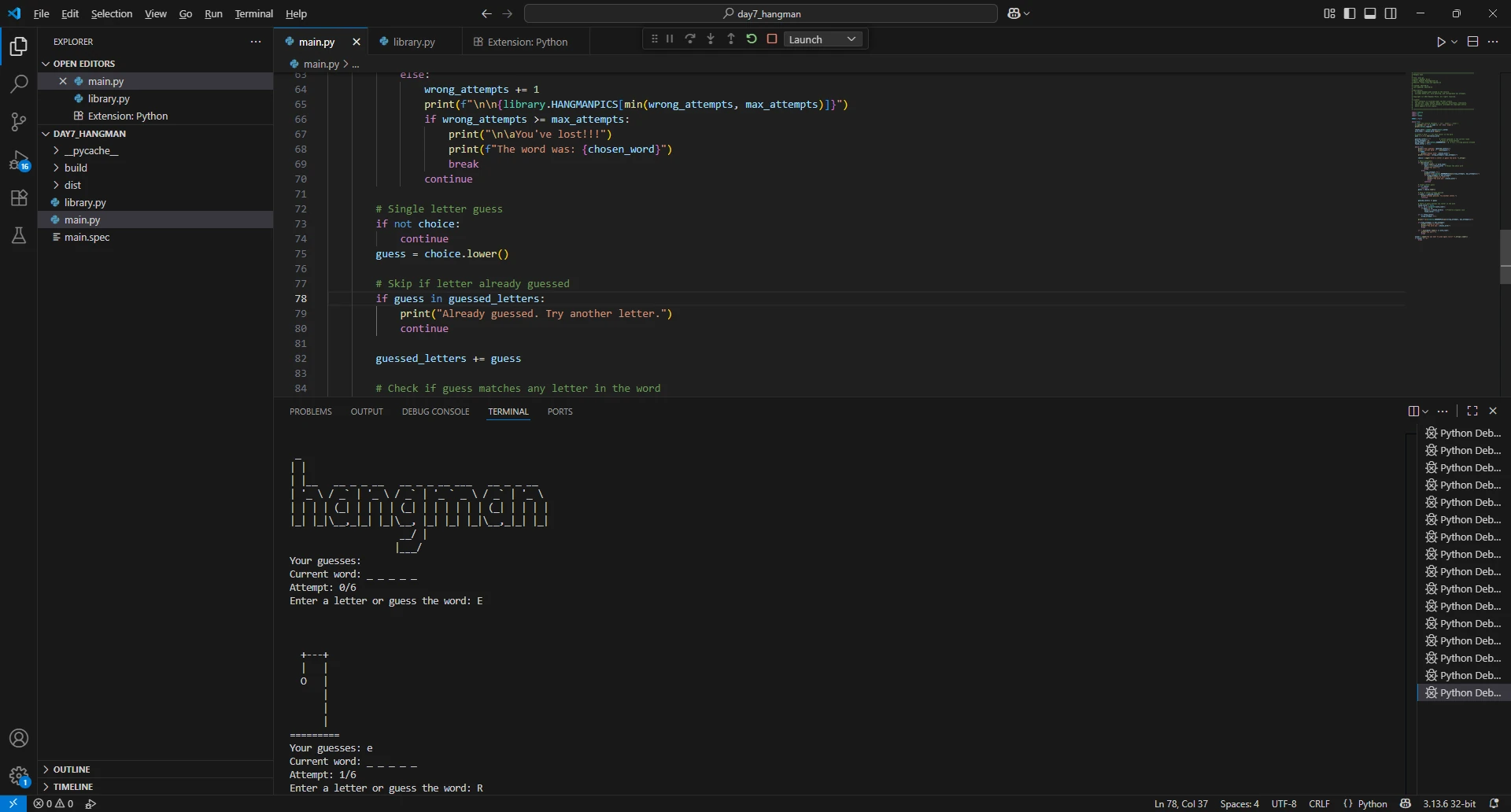
Co robi
- Losuje słowo z predefiniowanej listy
- Przy każdej błędnej próbie pokazuje ludzika z kresek w ASCII
- Pozwala zgadywać litery albo całe słowo
- Radzi sobie z wielkimi i małymi literami oraz powtórzonymi próbami
- Pokazuje moje rosnące supermoce w Pythonie
Dlaczego to uwielbiam
To nie tylko gra — to mała kapsuła czasu pokazująca, gdzie teraz jestem w mojej programistycznej podróży.
Za kilka miesięcy spojrzę na to i pomyślę: „Wow… przeszedłem długą drogę.”
Ale na razie to czysta radość patrzeć, jak terminal wypełnia się podkreślnikami, ASCII artem i komunikatami o zwycięstwie (albo tragicznych porażkach).
Na koniec
Jeśli zaczynasz z Pythonem, zrób wisielca. Serio. To idealny plac zabaw do eksperymentowania z pętlami, logiką i magią ASCII. A jeśli uda ci się sprawić, że kod będzie czysty i będzie działał bez błędów, to już wygrałeś.
library.py
words = ["Apfel", "Banane", "Mango", "Kirsche", "Pfirsich", "Linux", "Kernel", "Docker", "Ansible", "Python"]

logo = ['''
 _
| |
| |__   __ _ _ __   __ _ _ __ ___   __ _ _ __
| '_ \ / _` | '_ \ / _` | '_ ` _ \ / _` | '_ \
| | | | (_| | | | | (_| | | | | | | (_| | | | |
|_| |_|\__,_|_| |_|\__, |_| |_| |_|\__,_|_| |_|
                    __/ |
                   |___/''']

HANGMANPICS = ['''
  +---+
  |   |
      |
      |
      |
      |
=========''', '''
  +---+
  |   |
  O   |
      |
      |
      |
=========''', '''
  +---+
  |   |
  O   |
  |   |
      |
      |
=========''', '''
  +---+
  |   |
  O   |
 /|   |
      |
      |
=========''', '''
  +---+
  |   |
  O   |
 /|\  |
      |
      |
=========''', '''
  +---+
  |   |
  O   |
 /|\  |
 /    |
      |
=========''', '''
  +---+
  |   |
  O   |
 /|\  |
 / \  |
      |
=========''']
main.py
# =============================================================================
# Hangman Game
#
# File: main.py
# Author: Raphael Münch
# Email: you@example.com
# Website: https://www.apt-upgrade.me
#
# Created: 2025-08-15
# Last Updated: 2025-08-15
#
# Description:
#   A simple Hangman game played in the console.
#   Includes ASCII art, word guessing, and configurable max attempts.
#
# Copyright (c) 2025 Raphael Münch. All rights reserved.
#
# License:
#   This software is licensed under the MIT License.
#   You may use, copy, modify, merge, publish, distribute, sublicense,
#   and/or sell copies of the Software, provided the copyright notice
#   above appears in all copies.
#
# =============================================================================

import library
import os
import random

DEBUG = False

while True:
    # Clear the console (Windows = 'cls', others = 'clear')
    os.system('cls' if os.name == 'nt' else 'clear')
    print(library.logo[0])

    chosen_word = random.choice(library.words)
    word_lower = chosen_word.lower()

    # Create a mask: "_" for each letter in the word
    mask = ["_"] * len(chosen_word)

    guessed_letters = ""           # Letters guessed in the current round
    wrong_attempts = 0              # Count of wrong guesses
    max_attempts = len(library.HANGMANPICS) - 1  # e.g., 6 wrong guesses allowed
    found_letter = False

    while True:
        print(f"Your guesses: {guessed_letters}")
        print(f"Current word: {' '.join(mask)}")
        if DEBUG:
            print(f"Chosen word: {chosen_word}")
        print(f"Attempt: {wrong_attempts}/{max_attempts}")

        choice = input("Enter a letter or guess the word: ").strip()

        # Whole word guess
        if len(choice) > 1:
            if choice.lower() == word_lower:
                mask = list(chosen_word)  # Reveal the whole word
                print("You win!!!")
                break
            else:
                wrong_attempts += 1
                print(f"\n\n{library.HANGMANPICS[min(wrong_attempts, max_attempts)]}")
                if wrong_attempts >= max_attempts:
                    print("\n\aYou've lost!!!")
                    print(f"The word was: {chosen_word}")
                    break
                continue

        # Single letter guess
        if not choice:
            continue
        guess = choice.lower()

        # Skip if letter already guessed
        if guess in guessed_letters:
            print("Already guessed. Try another letter.")
            continue

        guessed_letters += guess

        # Check if guess matches any letter in the word
        found_letter = False
        for i, ch in enumerate(word_lower):
            if guess == ch:
                mask[i] = chosen_word[i]   # Preserve original case
                found_letter = True

        if not found_letter:
            wrong_attempts += 1

        print(f"\n\n{library.HANGMANPICS[min(wrong_attempts, max_attempts)]}")

        if wrong_attempts >= max_attempts:
            print("\n\aYou've lost!!!")
            print(f"The word was: {chosen_word}")
            break

        if "".join(mask).lower() == word_lower:
            print("You win!!!")
            break

    answer = input("Do you want to play again (y/n)? ").strip().lower()
    if answer != "y":
        break