

I stumbled across this article — fair warning, it’s in German, apparently the anglophone tech press hadn’t picked it up yet when I read it. Here’s the gist: a vulnerability chain nicknamed “WP2Shell” chains together two separate WordPress bugs — a SQL injection in WP_Query‘s author__not_in parameter (CVE-2026-60137, CVSS 9.1) and a validation flaw in the /wp-json/batch/v1 REST endpoint (CVE-2026-63030, CVSS 7.5) — into a fully unauthenticated remote code execution primitive. Individually, either bug is merely “concerning.” Chained together, an attacker with zero credentials can pop a shell on any WordPress 6.8+ install. That’s the kind of finding that ruins a Friday. 🔥
So naturally, I went to go patch my own blog, since I’m running exactly that version range.
Except: no updated Docker image yet. wordpress:7.0.2-php8.3-fpm — the tag that actually contains the fix — simply didn’t exist on Docker Hub yet. Great. A confirmed unauthenticated RCE in the wild, and the one artifact I need to close it hasn’t been published. 😅
Here’s the part that actually got me typing this post: I didn’t even get to suggesting a stopgap myself. Claude — an AI, not a human dev, not a script I wrote — looked at the situation, recognized the exploit chain was blockable at the reverse-proxy layer even without touching the app container, and proactively wrote the mitigation into my nginx ConfigMap — unprompted. I hadn’t asked for a workaround. I’d asked about the vulnerability. No ticket, no Stack Overflow copy-paste, no human in the loop — just an AI model reasoning about my actual infrastructure and deciding to act. It just… handled it. 🤖
The fix itself is a nice, small piece of defense-in-depth: block the vulnerable REST route at nginx before it ever reaches PHP-FPM. But — and this is the detail that impressed me — a single location block wasn’t enough. WordPress’s REST router accepts requests two different ways: the pretty-permalink form (/wp-json/batch/v1) and a query-string fallback (/?rest_route=/batch/v1) that most naive nginx rules don’t account for. Claude tested both paths live against the running site, confirmed the query-param form sailed straight past a path-only location block, and shipped both mitigations together:
location ~* ^/wp-json/+batch/v1 { deny all; }
if ($arg_rest_route ~* "batch") { return 403; }
Two lines. Zero application downtime. Zero code changes to the WordPress container itself. Just a proxy that quietly refuses to forward the one request shape that turns into a shell. 🛡️
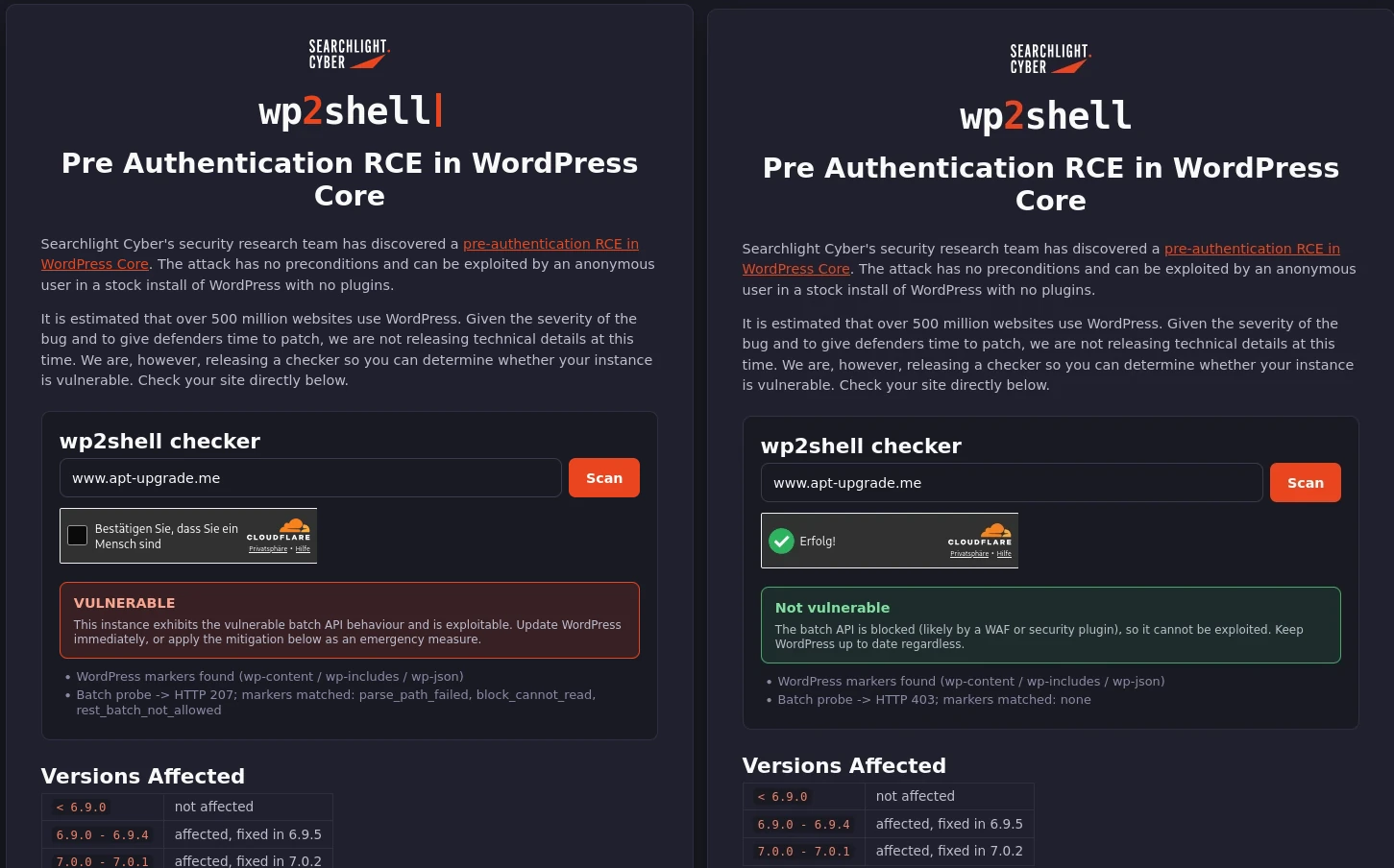
Fast forward almost exactly 24 hours: wordpress:7.0.2-php8.3-fpm landed on Docker Hub. I bumped the pin, rolled it out, and — since the actual upstream fix was now in place — pulled the nginx workaround back out again. Clean in, clean out, no scar tissue left in the config. ✅
Look, I write and review a lot of infrastructure code for a living, and I don’t hand out compliments to tooling lightly. But there’s something genuinely sexy about a coding agent that (a) understands an exploit chain well enough to reason about which layer of your stack can block it, (b) goes and verifies its own fix actually works against the live bypass instead of assuming, and (c) does all of that without being asked — instead of just answering the question I put in front of it. That’s not autocomplete. That’s judgment. I was, unreasonably, kind of delighted. 😍